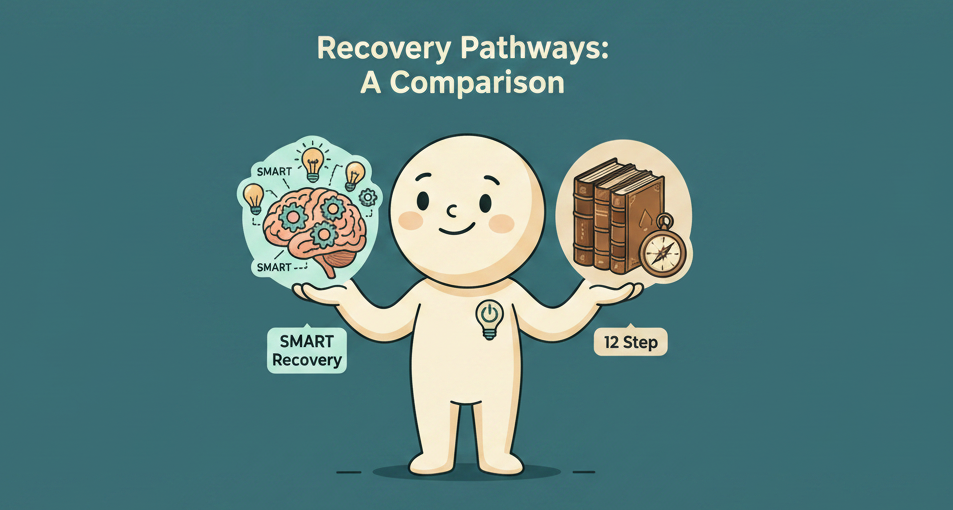
If you’re exploring recovery options, you’ve probably come across both SMART Recovery and 12-step programmes like Alcoholics Anonymous (AA). Both have helped many people. But they’re built on very different foundations, and understanding those differences can help you find what works for you.
I use a SMART Recovery informed approach in my coaching. That doesn’t mean I think 12-step is wrong — it means I offer a secular, evidence based alternative that many people find more aligned with how they see the world. Here’s an honest comparison. For a broader look at what secular recovery coaching involves, that article goes deeper into the philosophy.
What Is SMART Recovery?
SMART Recovery (Self-Management and Recovery Training) is a science-based programme that helps people manage addictive behaviours. It draws on Cognitive Behavioural Therapy (CBT), Rational Emotive Behaviour Therapy (REBT), and motivational techniques. It’s secular, meaning it doesn’t require any spiritual or religious belief.
SMART Recovery focuses on four key areas: building and maintaining motivation, coping with urges, managing thoughts and feelings, and living a balanced life. These are practical, learnable skills — not steps to follow or a higher power to surrender to.
What Is the 12-Step Approach?
The 12-step model, developed by Alcoholics Anonymous in the 1930s, is built around a structured programme of steps, peer support, and for many people, a spiritual or higher-power framework. It has helped millions of people worldwide and remains one of the most widely available forms of recovery support.
Key Differences at a Glance
| Aspect | SMART Recovery | 12-Step (AA) |
|---|---|---|
| Foundation | Science-based (CBT, REBT) | Spiritual / higher power |
| Belief system | Secular — no faith required | Spiritual framework central |
| Identity | You are not your addiction | "I am an alcoholic" identity |
| Approach | Self-empowerment & skills | Surrender & fellowship |
| Meetings | Open, time-limited | Ongoing, lifelong encouraged |
| Flexibility | Adaptable to individual needs | Structured 12-step programme |
| Tools | Practical CBT techniques | Steps, sponsor, literature |
Which Is Right for You?
The honest answer: there’s no single right approach. What matters is what works for you. Some people thrive in the fellowship and structure of 12-step. Others find the secular, skills-based approach of SMART Recovery more aligned with how they think.
If you’re someone who:
- Prefers a practical, skills-based approach over a spiritual one
- Doesn't identify with the idea of powerlessness
- Wants tools you can use independently between sessions
- Is non-religious, agnostic, or atheist
- Wants to work with a professional alongside peer support
…then a SMART Recovery informed approach may be a strong fit. But the two aren’t mutually exclusive. Many people attend SMART meetings and 12-step groups, or combine peer support with professional coaching.
Wondering if professional addiction recovery coaching is right for you? That page walks through who benefits most and what to expect. You might also want to understand the differences between coaching and therapy to help you decide.
For practical tools you can start using today, read about mindfulness techniques for managing urges.
I’m a trained SMART Recovery facilitator and ran national UK meetings for many years. My coaching draws on that direct experience alongside the full SMART toolkit, tailored entirely to you. I’m independent of SMART Recovery as an organisation, I use their evidence based tools as part of a broader, personalised approach.
If you’d like to explore what that looks like in practice, get in touch or learn more about my evidence based, secular approach.